Personal project, app installable on a phone, built by directing an AI agent
Caderno: a Brazilian Portuguese notebook that fits in your pocket
I am learning Brazilian Portuguese. I wanted one place to translate a word, keep it with a real example and practise my conjugations, on phone and computer alike, even without a connection. I designed Caderno and had it built by an AI coding agent in one day, all the way to its release on my server.
The need and the constraints
A translator gives you a word, not the will to remember it. I needed a personal notebook that keeps every word with its meaning, an example and my notes, plus reliable conjugation tables. Three constraints shaped the requirements:
- Free. No subscription: translation goes through the free MyMemory service, capped at 5,000 characters a day. Caderno sets itself a more cautious 4,500-character limit and remembers translations already made, which cost nothing.
- Data that stays mine. Only the text to translate is sent to the service; notes, examples and entries stay on my server.
- Usable anywhere. The app installs on an iPhone and works offline: the notebook and conjugations stay readable without a connection.
What the app does
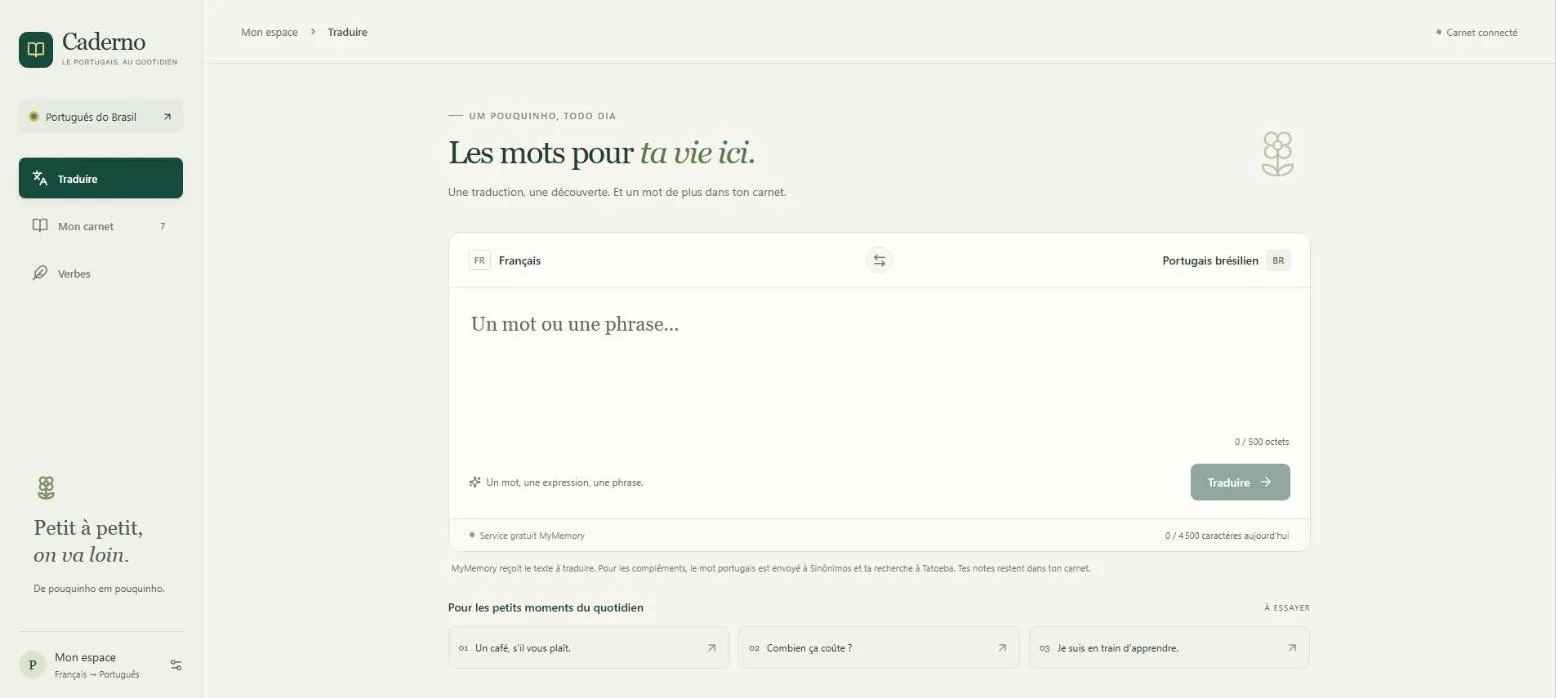
- Translate from French to Brazilian Portuguese and back.
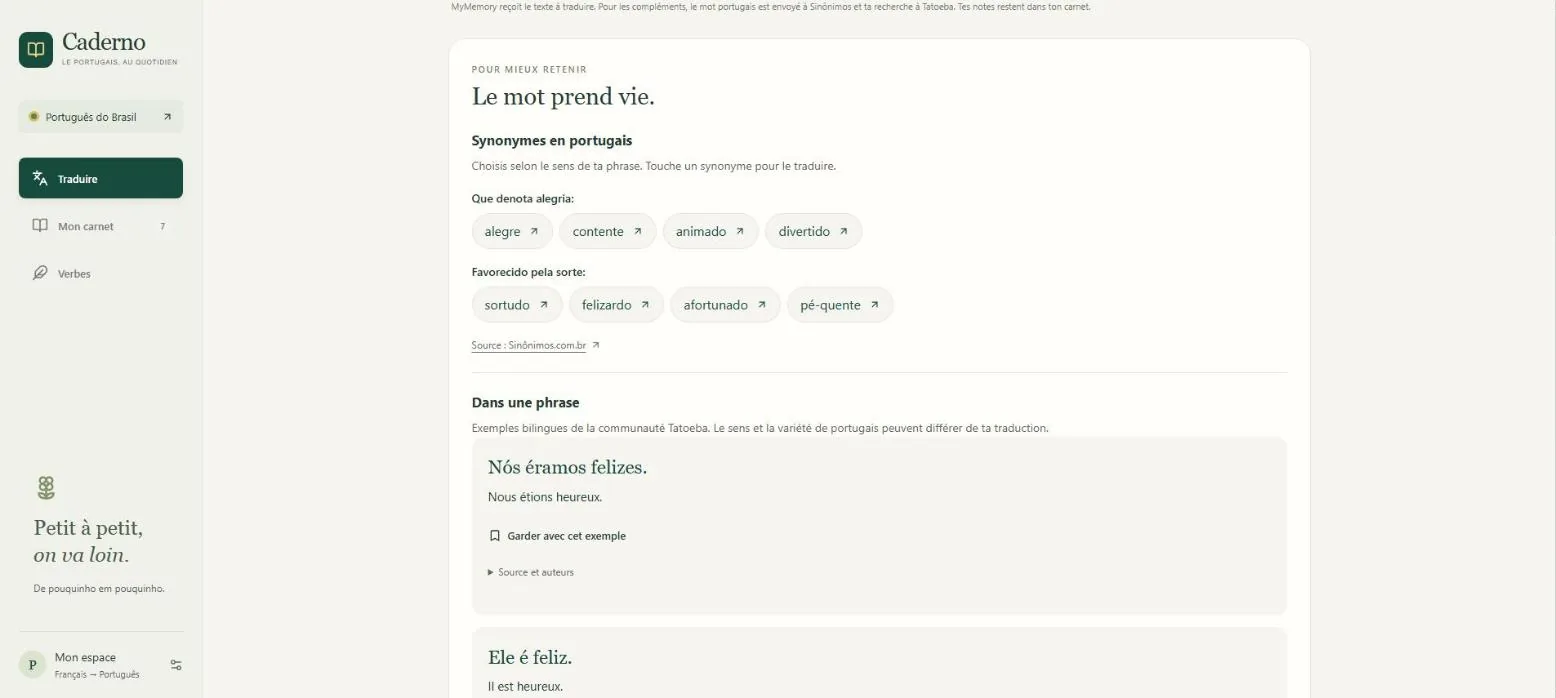
- Understand the word: synonyms grouped by meaning and bilingual examples, with their source and authors.
- Keep the word in the notebook with the chosen example, find it with an accent-insensitive search and review it with flashcards.
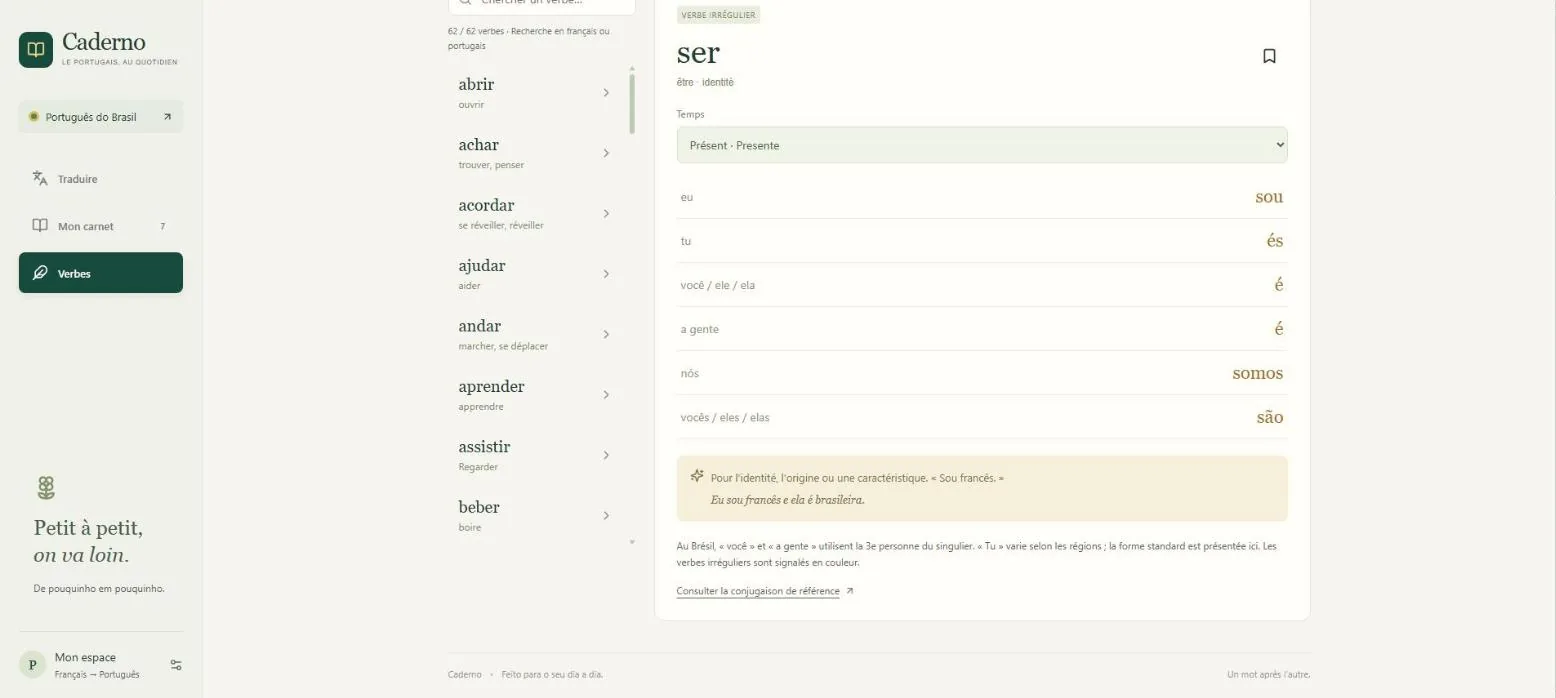
- Conjugate 60 everyday verbs in four tenses, and add your own verbs, whose forms are fetched from a reference conjugation site.
- Back up the notebook to a file and import it again without overwriting existing entries.
Verifiable results
- Counted765 verb forms checked one by one against the reference conjugation.
- Counted26 automated tests passing: 11 on data and the API, 14 browser journeys (Chromium, and WebKit at iPhone size), 1 offline reading test.
- RecordedLive over HTTPS since 10 October 2026; the server's two other apps still respond.
- RecordedPassword access, protected session cookie, request origin check and sign-in attempt limit. Dependency audit: no vulnerability reported.
Known limits
- Free services. They can be unavailable, and a rare word may have neither synonym nor example.
- Examples to double-check. Not every example sentence is in Brazilian Portuguese; each one keeps a link to its source.
- A real iPhone. The tests simulate an iPhone; installing on an actual device is not covered by the automated tests.
How I had it built
Vibe coding does not replace rigour, it moves it. I did not write the code, but I set what it had to do, what it must not do, and how to prove it was done.